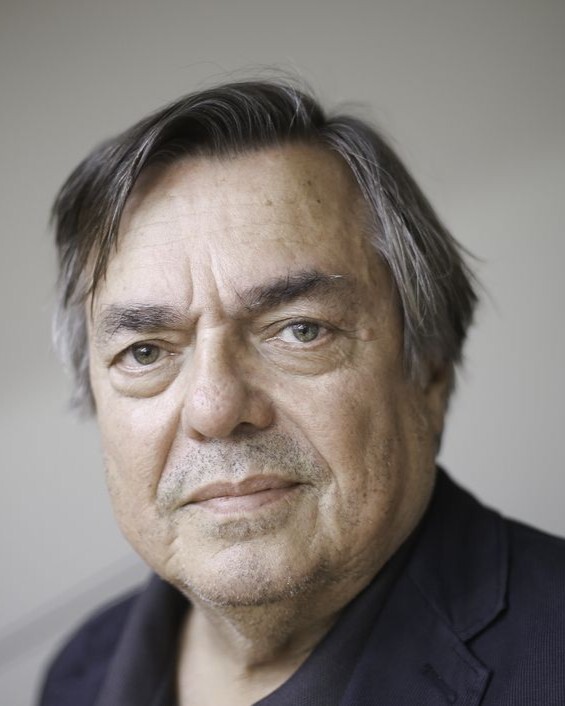
Drago Jančar: “I Fear Those Who Tell Us How We Should Think and Live.”
Publication: 23 March 2026

“The essence and significance of Europe in its current form is precisely that we are safer – both culturally and in terms of identity – than ever before,” you told me in the spring of 2019. Despite some worrying developments that were already taking place in individual countries of our region at the time, we still remained quite optimistic about the future overall. Looking back, it seems that the world is now changing completely and irreversibly. How do you see it today?
“Safer than ever before?” It’s unbelievable that I said that to you just seven years ago. Apparently, I was still living in the happy mood of the time when we told ourselves that nothing better had happened to us in recent centuries than Europe as a common space of democracy, open borders and human rights.
Although someone once called me a “seismologist” of cultural and social upheavals, in my musings I apparently failed to notice that the ground beneath our feet was already shaking. The war in Yugoslavia seemed to me to be the last episode of the ideologically and nationalistically insane 20th century. But now, in the face of the terrible war in Ukraine, the horrific events in the Middle East, and a divided America, Europe is also becoming increasingly confused, everyone is debating armament, and peace is receding into the distance. How is it possible that we have found ourselves in such an uncertain situation so quickly? It seems to me that in the years following the fall of the Berlin Wall it was much easier to talk about the future – as if we all knew what we wanted back then. Now, it is no longer so obvious.
Culture is what defines who we really are. Recently, we have been hearing more and more grandiose phrases about “heroic history” or “the greatness of the nation”. And this is mainly from politicians who have a very superficial knowledge of the past, if they understand it at all. Most of your books are rooted in history – history that is also happening today, to quote our previous conversations. What exactly is the “history” that you think is “happening today”? Or does the wheel sometimes turn full circle and we return to events and experiences we already know?
I don’t know if it’s a circle. I think history is rather “the blind tumult of man”, as the Slovenian writer Edvard Kocbek claimed. At first glance, it seems that the great right-wing and left-wing political and cultural movements that flooded the streets of European cities in the 1930s are being reborn in a new guise. However, today everything around us is completely different. New technologies, the internet, social networks, the decline of traditional media that serve political parties or lobbyists’ interests – all this makes us feel lost, almost plunged into chaos and deprived of peace, as we face an uncertain future. After the great European integration, I have written and spoken many times about the fact that Europe will be strong and united if it finds a vision that also encompasses the past; not only its centuries-old culture, but also the antithetical worlds on both sides of the Iron Curtain. We missed an opportunity for the West to understand more deeply and fully what life in communist dictatorships meant. For the East to understand that we will not move from dictatorships to a happy Arcadia of democracy – I thought so myself – but that we will wake up in a capitalist system where freedom is not so obvious; where those who own capital can subjugate the media, politics, and even the justice system. We lack shared experiences and mutual understanding in this area, which is why it seems that we are going through another historical cycle. Despite everything, I remain optimistic and believe that this cannot end like the turbulent and chaotic 1930s.
“Three plagues, three contagions, threaten the world. The first is the plague of nationalism. The second is the plague of racism. The third is the plague of religious fundamentalism,” Ryszard Kapuściński once said. In today’s society, which, under the influence of populists, demands unambiguous, black-and-white decisions from everyone, can people of culture still do something to oppose all this?
The fourth plague, I would add, is the plague of human stupidity; the worst of all the ones mentioned. We live in a time when, thanks to the widespread availability of information, it seems that we have reached the pinnacle of democracy: everyone can say what they want on any topic. This is true, but at the same time we see how much brutality and vulgarity is sweeping across social media and various online forums. Sometimes I say to myself: before the advent of the internet, I had no idea what kind of people I was living among. But opinions expressed in this way are, of course, quite alluring and not at all isolated. And they drag us down. What can people of culture do when this omnipresence of information has taken over the world, where the hierarchies of values of thinking and ethics are disappearing and criteria are disintegrating? Someone who has written dozens of books carries the same weight in this flood of online opinions as someone who, at best, has perhaps read one.
Writing is a reflection for you, a response to certain political or cultural events, but also a record of your impressions from travelling to various places – and that is what “Archipelagos. A Personal Atlas” is, a book containing your essays in Polish translation, recently published in Kraków. These texts transport the reader through time and space – from the early 1990s and the siege of Vukovar in 1991 to the Russian aggression against Ukraine in February 2022, from Korčula and Trieste to the misty fields of Flanders, full of tragic memories of the First World War, and today’s Catalonia, which is still fighting for its identity. Could you point to an essay from this collection that you wrote with some specific thoughts in mind?
I don’t think I discovered any fundamentally new truths about the times I travel through, which are the times of great change, social crises, and human hopes for a different life. Even in my essays, I am simply a writer who follows the developments and people, observes and wonders how the inertia of the difficult history of our part of the world affects our lives: mine, yours, everyone’s. And they contain very little in the way of salvatory ideas for the future. Personally, I am wary of thinkers who know exactly how societies should be organised and tell us how we should think and live. I enjoy cultural diversity, and if my writing carries any message, it is at most that we must live with this diversity and accept it with open arms and eyes sparkling with curiosity. Of course, I also hope that of all the things we did in good faith, as I write in “Archipelagos…”, Yugoslavia and the scenario of its collapse will not be repeated.
“The fates of all small nations in Europe are uniquely intertwined. When bad things start to happen somewhere in Europe, when there are attempts to move towards dictatorship, it affects everything; I would say it’s like a domino effect,” you told me during one of our earlier meetings. We often talk about what the once popular – now much less so – idea of Central Europe means today. Are we still able to break out of the vicious circle of focusing solely on ourselves and start looking at one another – Slovenians, Poles, Croats, Czechs, Lithuanians, Hungarians, and others?
Central Europe in the 1980s was an idea of openness, mutual cultural intermingling, personal freedom, and open borders. It is true that it was also strongly linked to tradition, because at that time the past seemed much better than the closed societies of the East and the whole of Europe divided by barbed wire and watchtowers. It was not an idea of small or large political nationalisms. At the time, we believed that what Joseph Roth wrote was true: Galicia is Slovenia’s northern sister. Today, the idea of cultural openness has been taken up by politics, which has also taken over every island of our Central European “archipelago”. Although we see clear signs that right-wing and left-wing politicians everywhere in these lands are trying to subjugate each other’s social systems, I would be quite cautious about making frivolous statements that we are on the verge of dictatorship. When I spoke earlier about “dominoes”, it was just another warning, a memento, of which there are indeed many in my essays. But despite the usurpation of power, the manipulation of public opinion, and even the incitement of conflict, I still believe that dictatorship will not prevail anywhere. We still have democracy, we have our Europe, we have culture and art, and above all, we have the individual, the citizen of a new generation, who will not allow all this to be taken away from them.
Translated from the Polish by Tomasz Bieroń
About authors
Copyright © Herito 2020
Designed with  by
OTREE
by
OTREE