Worth a look
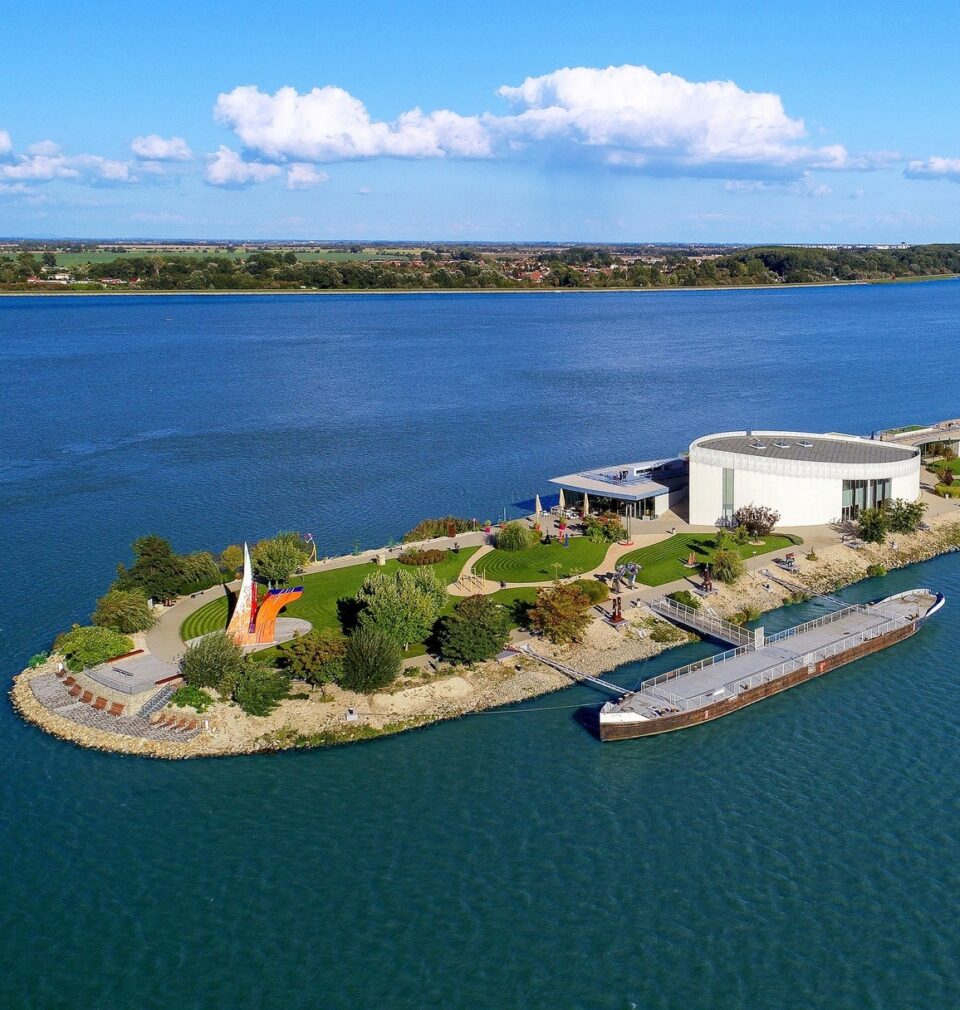
Autumn Exhibitions at the Danubiana Meulensteen Art Museum in Bratislava

Art and Heritage in Central Europe
Check out Autumn exhibitions at the Danubiana Meulensteen Art Museum in Bratislava:
– “Patrícia Koyšová – Free fall” – until 01 November 2026
Falling into Oneself. When the name Patrícia Koyšová is mentioned, most of us think of cultivated, yet unconventional abstract paintings created with a compressor and airbrush. Amidst the flood of global and Slovak abstract painters, she managed to build her own, unmistakable artistic language. A language that has gained many supporters – including the author of these lines. Recently, under the influence of various life changes, she began to experience doubts, hopes, joy, and tension in a different way, which comes when searching for truth in art and in herself. The tools she had used until then were no longer sufficient for expressing these emotions, so she reached for ropes. She dipped them in paint and created large-format canvases with them. She swung them, and struck the canvas, sometimes with such intensity that the ropes painfully hit her own body. Thick ropes woven from many smaller fibers seemed to symbolize the complexity of human destinies.
Read more: https://danubiana.sk/en/vystavy/volny-pad
– “Milan Bočkay – Tail Light (Retrospective)” – until 01 November 2026
The creator of a programme of analytical painting based on the principle of trompe l’oeil (optical illusion). Member of the avance-retard artists’ group. He belongs to the circle of secondary-school graduates under Prof. Rudolf Fila (School of Applied Arts, 1961 – 1965) who, at the end of the 1970s, developed a new visual form of the concept with the aim of preserving the inner authenticity of their work. He studied at the Academy of Fine Arts under Prof. D. Milly and Prof. P. Matejka (1965 – 1971); in 1982 – 2008 he taught at the Josef Vydra School of Applied Arts in Bratislava. At the centre of Bočkay’s artistic conception lies the age-old problem of art and illusion, of reality and fiction.
Read more: https://danubiana.sk/en/vystavy/zadne-svetlo-retrospektivny-pohlad
– “Fan Xueyi. The Magic of Ink” – available until 25 October 2026
Ink painting is a traditional Chinese art form. Water and ink are mixed on an inkstone to create different shades of black, then applied with a brush to hand-made bast paper. The amount of water, the brush and the stroke itself control the ink’s intensity and width.
Traditional ink painting usually joins image and poem. Making an ink painting is like writing, which is why it is also called literati painting—scholar painting—characterized by freehand lyricism. This is very different from Western painting’s focus on geometry and perspective.
Ink painting pursues the mood of poetry and a sense for nature. Between being and not-being, fullness and emptiness, yin and yang, it expresses the relationship of humans and nature, change of time and space, and the unity of the substance and its boundary. It is closer to philosophy and culture. The beauty of ink painting is not just visual, it is spiritual.
Fan Xueyi likes the uncertainty of ink. It is like life: fluid, seemingly there and not there. As ink changes, the mind perceives the relationship between oneself and nature. What flows from the tip of the brush is a map of the heart. In today’s flood of multimedia, this traditional medium lets us wander through mountains, rivers, trees and flowers—between heaven and earth. Gaining the power of wisdom through this process is simply an elegant way of living, a pursuit of Zen.
Read more: https://danubiana.sk/en/vystavy/kuzlo-tusu
– “Ivan Ouhel – Beneath the Surface” – available until 29 November 2026
Ivan Ouhel’s work has a special place in the context of Czech art of the last decades. Although he was a member of the free group 12/15 Pozdě, ale přece and Umělecká beseda, his painting style always retained a distinct individuality. His landscapes depicted more than a specific place, becoming a means of capturing personal experience, memory, movement, and a person’s relationship to the surrounding world. The exhibition Pod povrchom / Beneath the Surface presents a cross-section of Ouhel’s work from the 1990s up to his last paintings. In addition to a focus on his chronological development, it examines all of the themes to which the painter repeatedly returned. Landscapes as well as figure, often an anonymous figure exposed to the pressure of the surrounding world, play an important role. Gradually, however, the person became a natural part of the landscape, not its center. Ouhel’s painting combines intuitive experience with thoughtful pictorial composition.
Read more: https://danubiana.sk/en/vystavy/pod-povrchom
Copyright © Herito 2020
Designed with  by
OTREE
by
OTREE