Worth a look
Exhibition “Sacred art in the age of commerce. Czech Sacred Art 1990–2026” at the Museum of Modern Art in Olomouc

Art and Heritage in Cenrtal Europe
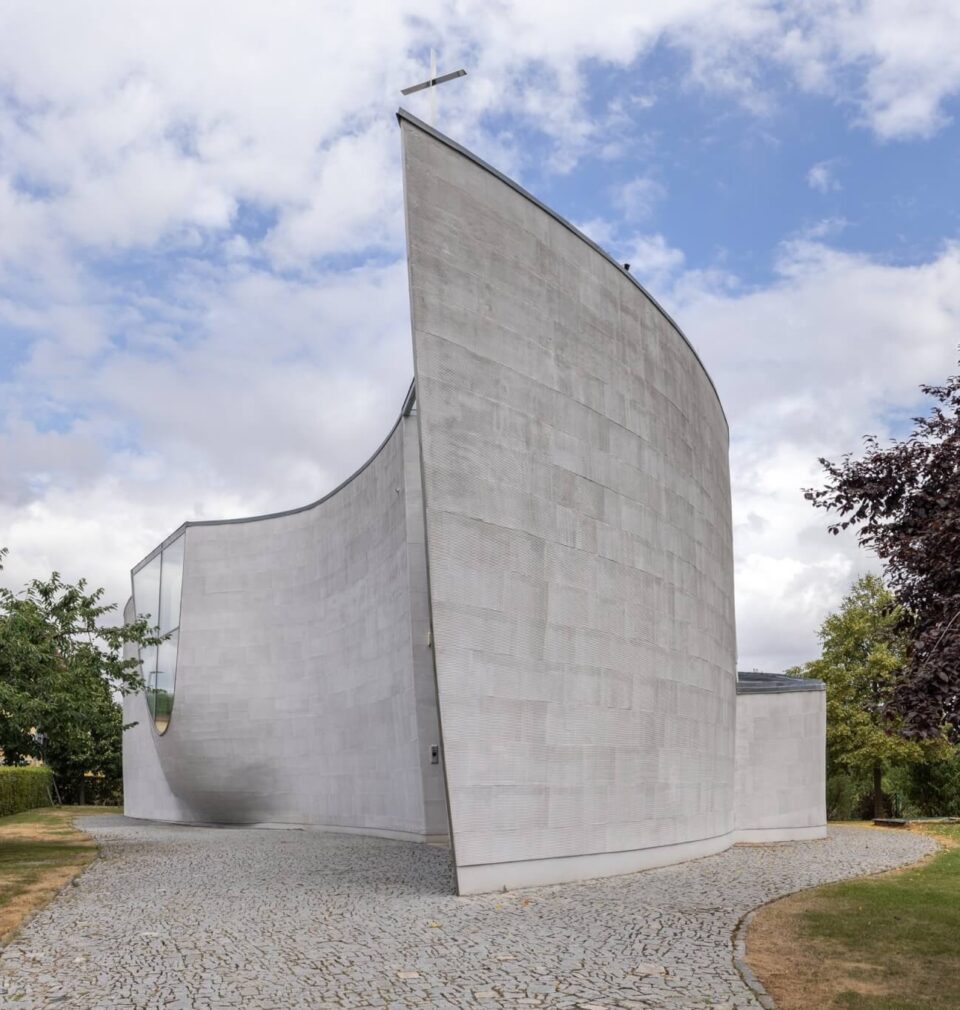
What bold architectural structures—churches and chapels, as well as imaginative interiors for spiritual spaces—were created in the free society after 1989? The answer is provided by the exceptional exhibition “Sacred Art in the Age of Commerce / Czech Sacred Art 1990–2026”, on view at the Olomouc Museum of Art from October 22, 2026, through March 14, 2027. This is the first time experts have charted more than three decades of architecture, fine art, and design created for sacred spaces in the era of freedom. The project follows up on the exhibition “Sacred Art in Unholy Times / Czech Sacred Art 1948–1989” (2022).
After 1989, churches gained the freedom to expand their activities. This also gave rise to the need to build new churches, chapels, and community centers, or to renovate existing places of worship. “It was precisely these changes that served as the impetus for the creation of many significant architectural and artistic projects. Their design involved figures who had been active even during the communist regime, such as architects Tomáš Černoušek, Viktor Dohnal, and Jan Soukup, and artists Ludvík Kolek, Karel Rechlík, and Karel Stádník. They were later joined by other prominent artists, including Marek Jan Štěpán, Josef Pleskot, Zdeněk Fránek, Jan Jemelka, and Otmar Oliva,” lists curator Šárka Belšíková.
Today, new churches often serve more than just a religious function. “In developing cities, they are becoming natural community centers and gathering places,” adds exhibition co-author Ivo Binder, noting that the exhibition also focuses on the restoration of liturgical spaces in accordance with the principles of the Second Vatican Council, as well as the phenomenon of modern chapels, Stations of the Cross, and small sacred structures in the countryside.
The restoration of church property returned through restitution is a topic in its own right. Many historic buildings were in poor structural condition and required extensive renovations. Civic initiatives also contributed to the restoration of this sacred heritage, for example in Neratov, Zlaté Hory, and Moravský Beroun.
Like the previous exhibition project, this one is also dedicated to non-Catholic religious buildings, such as the congregational houses of the Evangelical Church of Czech Brethren, where artists such as Miroslav Rada, Barbora and Jiří Veselí, and Vít Cimbura made their mark. Among others, the Brethren Church was particularly active in construction during the period under review, collaborating with leading Czech architects and visual artists such as Zdeněk Fránek, Václav Cigler, and Karel Malich. The achievements of other churches operating in our country are also documented.
The project also includes an extensive publication titled “Sacred Art in the Age of Commerce / Czech Sacred Art 1990–2026”, featuring scholarly essays by leading experts in the fields of theology, history, and art history. The scholarly essays by Tomáš Petráček, Jiří Hanuš, Michal Sklenář, Ivo Binder, and Anna Boučková are complemented by extensive photographic documentation and a section featuring artist and architect profiles. This is the first comprehensive scholarly study of Czech sacred art covering the recent period of the last thirty-six years.
Read more: https://muo.cz/en/vystavy/sacred-art-in-the-age-of-commerce/
Copyright © Herito 2020
Designed with  by
OTREE