Worth a look
Two Temporary Exhibitions at the Hungarian National Gallery in Budapest

Art and Heritage in Central Europe
Two temporary exhibitions are available at the Hungarian National Gallery in Budapest:
– “The Theatre of Painters. András Böröcz and László László Révész Performances from the 1980s”: the performances of András Böröcz and László László Révész in the 1980s were among the defining, legendary events of the era. The artist duo, who originally studied painting – which is why their contemporaries referred to the events as “the theatre of painters” – developed a language full of irony, humour and playfulness, which uniquely combined performance with theatre and painting.
The exhibition provides an overview of Böröcz and Révész’s performances through documents and related artworks: it presents the collage-technique pages of the portfolio the two artists created between 1977 and 1986, accompanied by documentary photographs by György Makky, as well as a selection of works on paper by András Böröcz and László László Révész, and sculptures by Böröcz, that feature or revisit motifs from the performances. The exhibition also includes a site-specific installation by András Böröcz that reflects on the sets and props, as well as video recordings (by Nina Czeglédy and others), several of which were never exhibited before.
The exhibition is available until August 23, 2026.
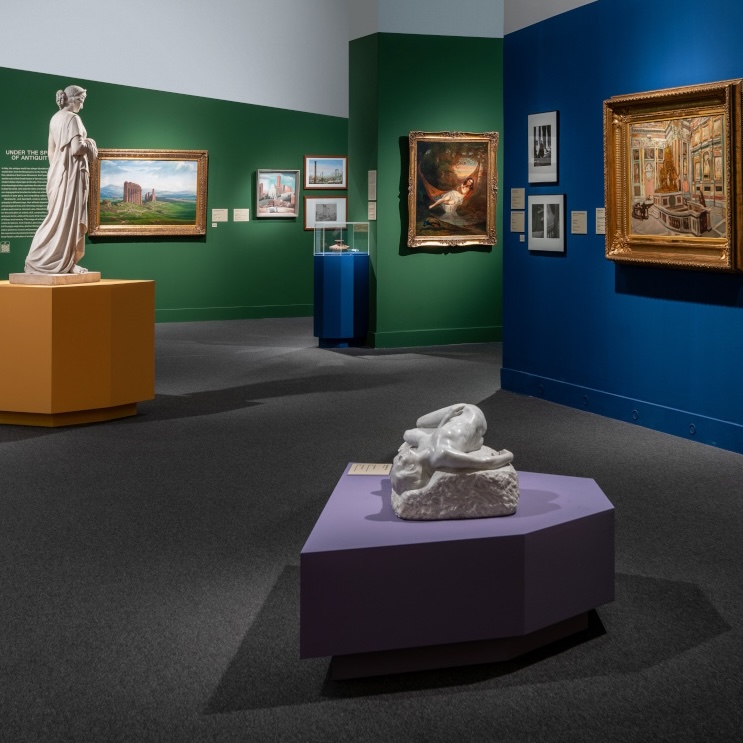
– “Dolce Vita. Impressions of Italy in Two Centuries of Hungarian Art”: the exhibition presents a selection of works from the nineteenth century to contemporary art, showing that Italy has always been a popular destination for travellers and an eternal motif and theme for artists in Hungary. The exhibition, which is part of the Bartók Spring International Art Weeks, presents around 150 works by 75 artists, including paintings, prints, photographs, sculptures, objects, and archaeological artefacts.
The Italian experience and the classical ideal of the Italian landscape were condensed in Hungarian art into a visual essence that also inspired the depiction of domestic themes. In the paintings of Antal Ligeti and József Egry, southern light effects make it home in a distinctively Hungarian panorama, the landscapes of the Lake Balaton and Danube, while in the works of Károly Patkó and Jenő Medveczky, bathing in the Balaton becomes the Hungarian version of scenes of the Lido.
The longing for the sweet life emerged as pop-cultural topos, but the concept of la dolce vita is not just a clichéd metaphor for joie de vivre. The exhibition highlights that the dolce vita phenomenon can be reflected in a sunny fantasy, in the activities of artists in Italy, living their bohemian period, or in Emese Benczúr’s vibrant Dolce Vita tableau made of colourful candy wrappers: sweets consumed for the sake of art.
The exhibition is available until August 30, 2026.
Read more: https://en.mng.hu/exhibitions/dolce-vita-impressions-of-italy-in-two-centuries-of-hungarian-art/
Copyright © Herito 2020
Designed with  by
OTREE
by
OTREE